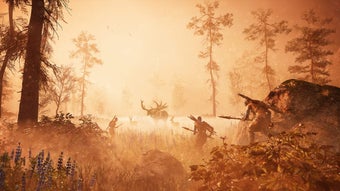
Far Cry: Primal reinvents Far Cry as Stone Age survival
Far Cry: Primal, developed by Ubisoft Montreal, drops the series into 10,000 BC and casts players as Takkar, a hunter rebuilding a tribe. The game centers on survival, visceral melee combat, primitive crafting, beast taming, and open-world exploration across Oros, with systems such as the Beast Master and an owl reconnaissance ability supporting stealth and assault. Fans of action-adventure and survival mechanics who enjoy animal-companion play and tribal conflict find a focused single-player experience in this prehistoric setting.
Primal places you in a survival-driven open world where hunting defines progression
Set in 10,000 BC as Takkar, the player begins defenseless and advances by learning to hunt, craft weapons like bows and spears, and secure resources. The core loop cycles between scouting, hunting prey, and using gathered materials to improve gear and the tribe’s standing. That emphasis on practical resource use turns many activities into direct steps toward tribal resilience rather than abstract collectibles.
The single-player focus makes companion systems and encounters matter more
Primal is strictly single-player, so companion mechanics and AI behaviour shape tactics during confrontations. Players can tame predators and, after specific skill unlocks, ride large tamed animals into conflict; combat relies on melee timing, bows, and throwable items instead of guns. These choices change encounter pacing and force attention to positioning, stealth, and environmental use in hostile camps.
Oros’s environments and constructed language give the world consistent character
The map spans redwood forests, taiga and swamps, each altering patrol patterns and available materials. A constructed Wenja language underpins NPC dialogue, which tightens immersion by reducing repetitive translated lines and making tribal interactions feel intentional. Audio and environmental cues support tracking and ambushes, and PlayStation 5 backward compatibility produces noticeably faster load times during travel and camp transitions.
Progression rewards targeted skill investment and tribe development
Skill trees expand taming, riding, and weapon capabilities, so players choose paths that suit their preferred approach. Survival mechanics such as hunting, fire management, and resource collection gate access to upgrades and influence over the Wenja. Several reviewers observed the mission structure follows familiar Far Cry patterns, which supplies clear objectives but reduces surprise for those seeking radically different mission design.
An inviting pick for players who prefer deliberate, exploration-first action
Primal is a patient, atmospheric choice for players who like measured progression and world-driven objectives. Its temperament rewards steady investment and curiosity rather than instant confrontations or competitive sessions. Players who favour brisk, match-based play may find the tempo mismatched, but those ready to settle into its mood will find a distinct prehistoric experience worth the time.